WW1 Pershing Wagons
Towards the end of the First World War, the American Expeditionary Forces (A.E.F.) placed a large order for narrow-gauge railway wagons to support military operations in France. Production was rapid, and the first shipment was ready by November 1917. In total, more than 2,800 wagons were manufactured in several configurations to wartime logistics needs: Box cars with a capacity of about 600 cu ft.
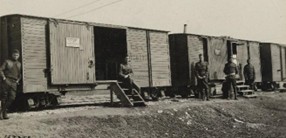 (National Archives, USA)
Tank cars capable of holding 2,000 gallons of liquid
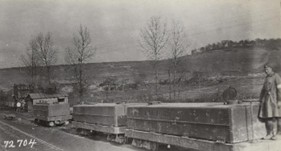 (National Archives, USA)
Flat cars rated for loads up to 22,000 lb
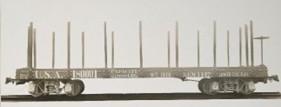 (National Archives, USA)
Gondolas carrying either 210 cubic ft or up to 22,000 lb
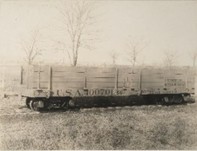
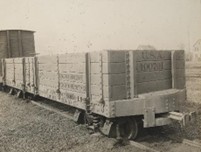
(National Archives, USA)
These wagons ran on the 60 cm-gauge railway network that snaked across the Western Front. The lines played a vital role in supplying troops, moving equipment, and transporting personnel in areas where roads were unusable due to mud, shell damage, or congestion. While the system was innovative and efficient, it was also lightweight by necessity: most of the track used only 25 lb/yd rail—similar to what the OKLR in yards and sidings today. This light infrastructure, combined with the relatively tall and narrow proportions of the box vans, meant that this wagon type was unstable and prone to derailing due to the rough nature of front-line railways, limiting their practical use during the conflict.
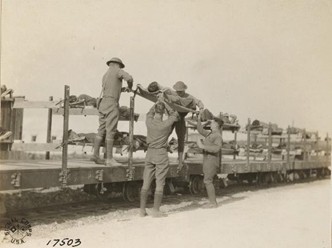 (National Archives, USA)
Flat wagons proved more reliable and were adapted for a wider range of roles. One notable modification involved fitting special stretcher frames for the evacuation of wounded soldiers from forward areas. The flats also served in general transport duties such as moving timber and engineering materials.
After the war, many of these wagons entered industrial service. The examples at the OKLR are believed to have been sent to the Nemours sand works in France. North of Paris. There, the original design was heavily modified: the chassis were narrowed from their standard 5 ft 7 in width to 4 ft, and each wagon was equipped with three skip bodies, roughly the same size as the big hudson skips at the OKLR already.
These modified wagons remained in service for many years until 1968 when the wagons were acquired by the late Peter Rampton for his private collection just up the road from the OKLR, Collection X. They spent a long period stored off the track - fortunately with some degree of cover, which helped preserve them.
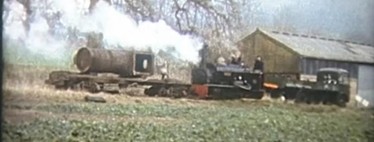 (Vale of Rheidol Railway)
The wagons did have some use at the collection as some of the bogies were temporarily put under some Isle of Man coaches which were also in the collection to provide rides around the estate on specific open days or as a complete unit being used on a demonstration line.
As the collection neared dispersal, members of the OKLR visited to examine what was there and identified several wagons as suitable candidates for acquisition and restoration, among other things.
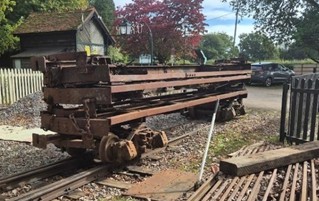
A member of the OKLR subsequently arranged to purchase three of these historic wagons. Discussions are ongoing between the railway and the current owner to determine the most appropriate future use for them, considering their history, current condition, and potential operational value. Restoration work is planned to begin once time, funding, and workshop capacity permit.